
ROSE OF JERICHO
The Ultimate Buyer’s Guide: Real vs. False Rose of Jericho Explained
Sep
Executive Summary (Meta Description)
Target Keywords
Introduction: Why Consumers Mistake These Two Desert Plants
The term “Rose of Jericho” is frequently applied to two distinct botanical species that share an extraordinary defense mechanism against severe drought. While both plants can curl into a desiccated ball and reopen when exposed to moisture, their underlying biology, geographic origins, and care requirements could not be more different. Whether you are seeking a historic relic from the Middle East or a vibrant green resurrection plant for your home, understanding these core differences will ensure you get the exact species you intend to purchase.
Biological Mechanics: Mechanical Uncurling vs. Cellular Revival
The True Rose of Jericho (Anastatica hierochuntica)
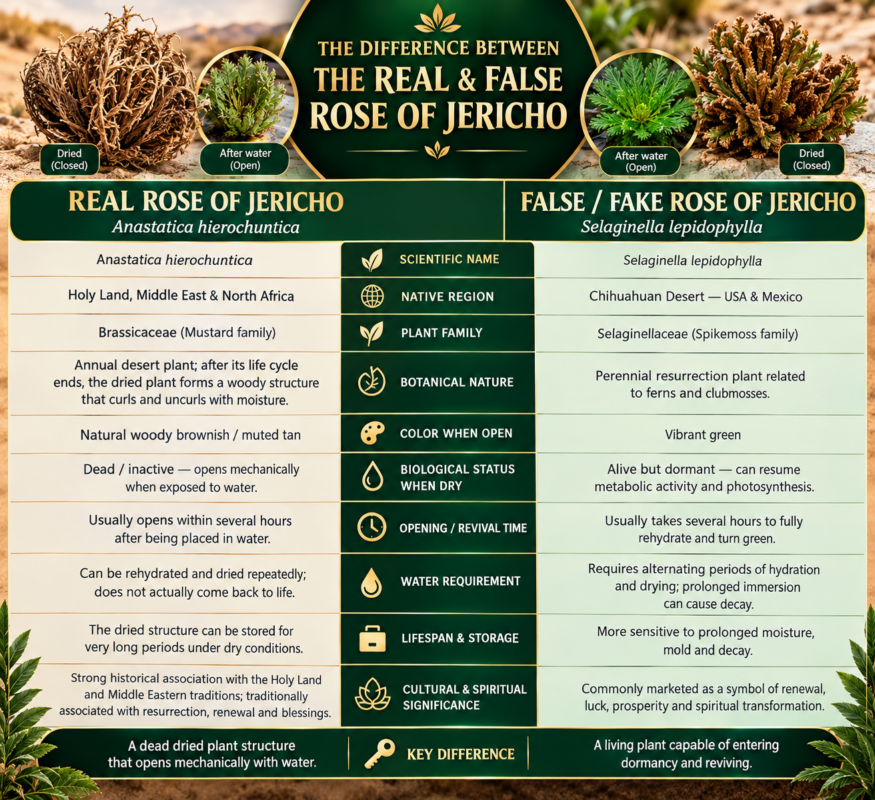
Hailing from the hyper-arid deserts of the Middle East, North Africa, and the Holy Land, the True Rose of Jericho is a woody annual plant of the Brassicaceae family. Once the plant completes its life cycle, it dies and curls inward to protect its seeds. When hydrated, the dead tissue absorbs water purely through physical capillary action, forcing the dried stems to uncurl mechanically within 1 to 4 hours. Because the plant structure is dead, it maintains a muted, dark tan or woody brown appearance upon opening.
The False Rose of Jericho (Selaginella lepidophylla)
Originating from the Chihuahuan Desert of North America, the False Rose of Jericho is a perennial spikemoss (Selaginellaceae family). This species is a true biological resurrection plant: it enters a state of extreme metabolic dormancy (anhydrobiosis) during dry periods. Upon hydration, its cells reactivate, photosynthesize, and restore full biological function, transforming the plant into a lush, vibrant green rosette over 3 to 24 hours.
Maintenance and Long-Term Preservation
Maintaining these two species requires distinct approaches due to their differing living statuses:
-
Long-Term Storage: The True Rose of Jericho (A. hierochuntica) is virtually indestructible. Because it is a inert woody structure, it can be wet, dried out, and stored in a dry space for decades without degrading or rotting.
-
Rot Prevention: The False Rose of Jericho (S. lepidophylla) remains a living organism. If left submerged in water for too long without dry rest periods, it easily succumbs to mold, fungal growth, and root decay. Users must allow it to dry out completely between hydration cycles.
Comparative Breakdown
| Feature | Real Rose of Jericho | False / Fake Rose of Jericho |
| Scientific Name | Anastatica hierochuntica | Selaginella lepidophylla |
| Native Region | Holy Land, Middle East & North Africa | Chihuahuan Desert (USA & Mexico) |
| Plant Family | Brassicaceae (Mustard family) | Selaginellaceae (Spikemoss family) |
| Botanical Nature | True woody tumbleweed (Dead structure) | Fern-like spikemoss (Resurrection plant) |
| Color When Open | Natural woody brownish / Muted dark tan | Vibrant green |
| Botanical Status | Dead / Inactive (Uncurls mechanically via water absorption) | Alive / Dormant (Revives and resumes photosynthesis) |
| Opening Time | Rapid (Opens within 1–4 hours in water) | Moderate (Takes 3–24 hours to fully green up) |
| Water Requirement | Can stay submerged briefly or left to dry completely | Requires dry rest periods; rots quickly if left in water |
| Lifespan & Storage | Virtually indestructible; storable dry for decades | Sensitive to mold and decay if kept too wet |
| Cultural Significance | Authentic Biblical & Middle Eastern heritage; symbol of resurrection & protection | Modern spiritual use (Wicca, Hoodoo) for luck and abundance |
If you are looking for an authentic historic artifact with deep Biblical roots and zero risk of rotting, the Real Rose of Jericho (Anastatica hierochuntica) is the ideal choice. If your goal is to observe a living, greening plant transformation for educational or decorative purposes, the False Rose of Jericho (Selaginella lepidophylla) offers the desired visual result with proper moisture management.
Related posts:
 False Rose of Jericho vs True Rose of Jericho: Key Differences
 True Rose of Jericho vs false Rose of Jericho
 The differences between the real Rose of Jericho oil and the oil of the false Rose of Jericho
 The flexible wonder of the desert: Rose of Jericho
 Jericho Rose
 The ultimate guide to the real Rose of Jericho